Ranges: What They Are and How to Think About Them
A player’s range is just the collection of hands they could realistically have in a situation.
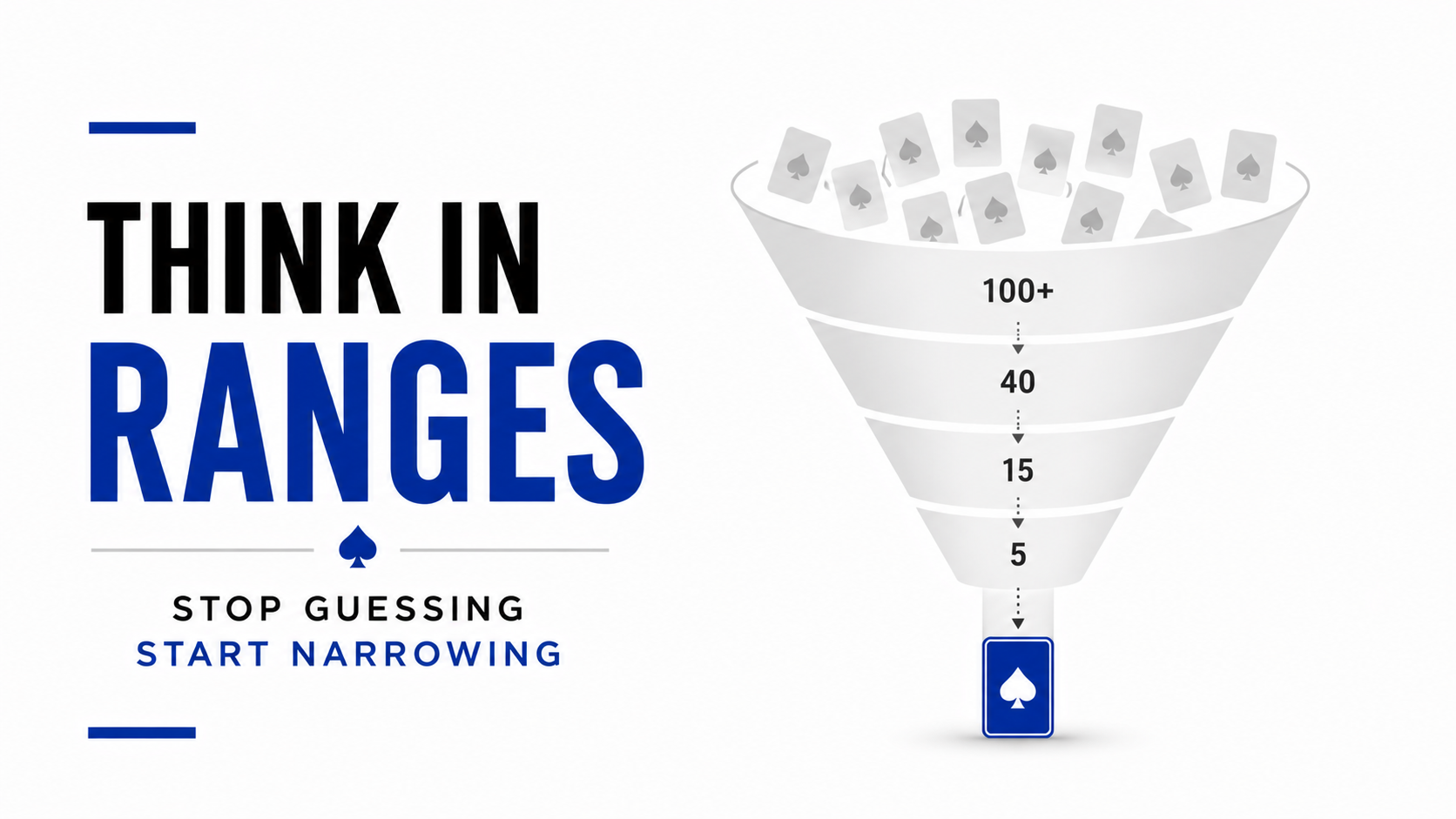
One concept you hear a lot in poker strategy is ranges. For many players the word sounds complicated, but the idea behind it is actually very simple.
A player’s range is just the collection of hands they could realistically have in a situation. That’s it.
When you think about ranges, you stop asking yourself “What exact hand does my opponent have?” and instead start asking “What hands could they have based on the way the hand has played out?”
Once you start thinking this way, the game becomes much easier to navigate.
Start With Player Type
The first thing I look at when putting someone on a range is how they’ve been playing. In live cash games, players tend to fall into pretty clear categories.
Is your opponent a tight nit who only gets involved with premium hands, or a complete maniac who seems willing to play almost any two cards?
A tight player opening a pot is usually representing a much stronger range than a loose player who has been splashing around all night.
Understanding the type of player you’re dealing with immediately gives you a starting point for what kinds of hands they might be holding.
Position Matters
The next thing I take into account is position. Position has a huge influence on the types of hands players are willing to play.
Hands that might be opened from late position often wouldn’t be played at all from early position.
For example, if a tight player opens from under the gun, their range is likely very strong. But if that same player opens on the button, their range can expand quite a bit because they’ll have position on the rest of the table.
Position alone can tell you a lot about the types of hands someone may have.
Table Dynamics Matter Too
Ranges aren’t just about the cards. They’re also influenced by what’s happening at the table. Live poker is full of small moments that can change the way someone plays.
Maybe a player just lost a huge pot and is now steaming a bit. When that happens, players often start opening up their range and getting involved in more hands.
Maybe someone announces they have to leave soon and suddenly starts trying to see more flops before they go. Or maybe a conservative player just won a big pot and tightens up because they don’t want to risk giving those chips back.
These kinds of dynamics happen constantly in live games, and if you’re paying attention they can tell you a lot about how someone’s range might be shifting.
Make Your Best Estimate
At the end of the day, putting someone on a range is really just making an educated estimate.
You’re taking everything you’ve observed during the session — player type, position, and table dynamics — and narrowing down the list of hands that make sense.
You don’t need to be perfect. The goal isn’t to guess the exact hand.
The goal is simply to narrow the possibilities so your decisions become easier.
Why Ranges Matter
Thinking in ranges helps you navigate the hand as it moves through each street.
Instead of reacting to a single hand, you’re considering the different combinations your opponent could realistically have.
As the hand progresses, you can begin eliminating hands that no longer make sense based on the action.
By the time you reach the turn or river, that range often becomes much narrower, and that’s when good decisions become much clearer.
Example: Narrowing a Range During a Hand
Let’s walk through a simple example you might see in a typical $1/$3 live cash game.
A relatively tight player raises to $15 from under the gun. Everyone folds and you call on the button with Q♦J♦.
When a tight player opens from early position, their range is usually fairly strong. At these stakes it might include hands like AA, KK, QQ, JJ, TT, AK, AQ, and sometimes AJs.
Calling on the button with a suited Broadway hand like QJ♦ is reasonable here because you’ll have position for the rest of the hand.
The Flop
The flop comes A♠ Q♣ 4♦, giving you second pair.
Your opponent continuation bets $20.
At this point, many hands in their range still make sense. Hands like AK, AQ, AA, KK, JJ, and TT could all reasonably make this bet on this board.
Since you hold Q♦J♦, you also block some of the strongest hands your opponent could have. AQ and QQ are still possible, but slightly less likely since one of the queens is already in your hand.
With second pair and position, you decide to call and see how the hand develops.
The Turn
The turn brings the 2♥.
Your opponent checks.
This action begins to narrow the range. Some strong hands like AK or AA may continue betting for value, while hands like KK, JJ, or TT might check to control the pot.
Since you still have second pair and position, you check back and take the free card while keeping the pot manageable.
The River
The river is the 7♣, and your opponent checks again.
At this point, many of the strongest hands would likely have continued betting earlier in the hand. The remaining range may now include hands like KK, JJ, TT, or occasionally a cautious AQ.
With your opponent showing weakness on both the turn and river, you decide to make a thin value bet of $18 to target those weaker pocket pairs that might still call.
He calls with JJ, and you take down the pot.
Why This Matters
Notice how the range started fairly wide before the flop.
As each street played out, more hands stopped making sense based on the action.
By the time you reach the river, the range is much narrower, which makes your decision much clearer.
That’s the power of thinking in ranges.